
By Adam Ives, governance and executive officer, NAHT The School Leaders’ Union | 4 min
If a union’s strategy exists as a snapshot of its industrial, political, social and internal priorities, then strategic governance serves as the mechanism for both establishing those priorities and ensuring their operational implementation. An effective governance structure must ensure a clear path for member voice from across all sections of the union to shape the strategy. Concurrently, it must provide an appropriate degree of democratic oversight of the strategy’s operational execution without inhibiting the agility required for its delivery.
The productive tension
Strategic governance allows for a productive tension to exist between the General Secretary and the governing body. An engaged National Executive is empowered to hold the General Secretary to account, ensuring the strategy reflects the direction of travel desired by the membership. This reciprocal confidence, derived from membership buy-in to a coherent strategy, reduces the temptation for operational interference.
When assessing whether an executive is appropriately focused on strategic governance, the following questions could be considered:
Is your governing body aware of the union’s strategy? Can they articulate this confidently to other parts of the democracy?
Do agendas focus on long-term direction and key turning points, rather than routine administration?
Are papers requesting strategic decisions rather than seeking the rubber-stamping of operational choices?
Is there an appreciation of the strategic risks and opportunities for expanding the union’s leverage and capacity?
Are there periodic reviews of the outcomes of decisions and the effectiveness of the union’s operations, governance and democracy?
Is the governing body engaged in dialogue with the wider membership, truly understanding their priorities?
Can the governing body respond to instructions and recommendations coming through the democracy (conference, councils, committees) while still supporting a coherent strategy?
Do the governing body members understand their distinct role in governance rather than implementation? Are formal training mechanisms (inductions, summer schools, mentoring) in place to sustain this understanding?
Proactive governance and the frontier issues
Contemporary trade union issues provide a crucial insight into where strategic governance is most essential. Challenges such as the just transition, artificial intelligence, the rise of far-right populism and shifts in the nature of work demand that unions, particularly their governing bodies, adopt a proactive rather than a reactive approach. This ensures that the overarching mission and strategy of the union are not disturbed by emerging challenges.
Viewing these challenges as various frontiers of change, unions with structures optimised for Triple-A governance (Anticipate, Agile, Adapt) will be better equipped. They will be able to anticipate disruption and understand where change is here to stay as it becomes legitimised.
As the first consequences of these changes appear on the periphery for union members, an optimised union will have the agility to engage in conversations about why action is needed and how to shift the strategy to respond. Finally, the union can adapt and implement a proactive shift before the challenges have begun to impact the members at large.
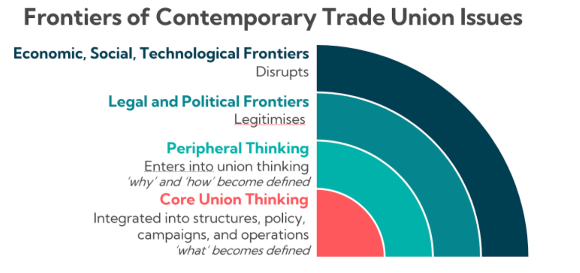
A salient example is the rise of far-right populism. This has been a disruptive social force for over a decade, which has more recently gained political legitimisation and become a credible existential threat to unions and workers. This threat should have been anticipated and its risks mapped. As it permeates the peripheries, impacting specific communities and workplaces, the governing body must then be in dialogue about why action is necessary and how to pull the various operational areas together to respond. Finally, unions will reach the point of adapting – articulating what they will do to protect members’ interests and beginning to engage the wider membership with the issue.
Leading the ‘why’ and ‘how’
Governing bodies are key to establishing the ‘why’ and ‘how’ of this strategic response. Members will not be universally aware of challenges before they see their consequences, nor do they possess the vantage point necessary to anticipate issues. It is therefore essential for a governing body to lead, highlight voices that are already affected, and begin considering the longer-term strategic risks.
Equally important is the governing body’s understanding of the resources and tools available in formulating an approach. This must be done in a way that maintains strategic and institutional coherence rather than being driven by reactive, isolated responses. This is particularly vital as many contemporary issues result in a polycrisis, requiring the management of conflicting impacts, priorities and strains on resources from various operational areas.
Find out how your governance measures up
Unions 21 has produced an audit process for you to assess the standard of governance at your union. Take the audit now and benchmark yourself against other unions.
 This article is supported by Slater and Gordon